
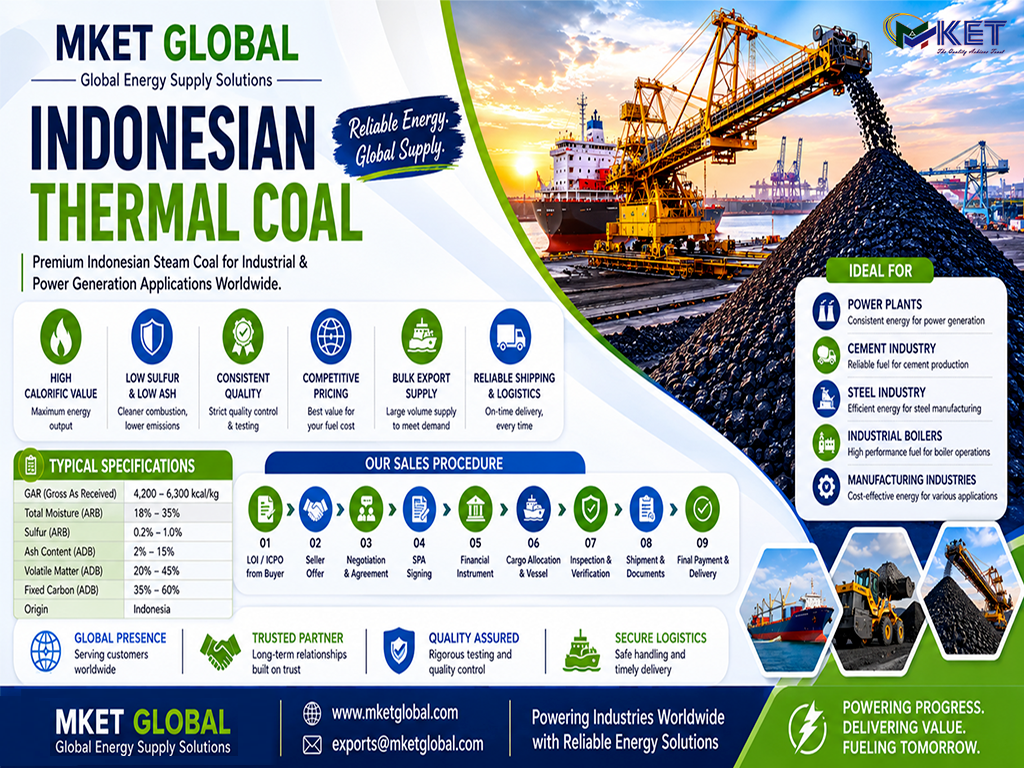
MKET GLOBAL provides professional international coal trading and export support by connecting reliable Indonesian coal suppliers with global buyers and importers. Our structured sales procedures ensure transparency, efficiency, and secure transaction management throughout the export process.
Email: exports@mketglobal.com
Why Indonesian Thermal Coal?
Indonesian Thermal Coal is widely preferred in international markets because of:
- Competitive export pricing
- Consistent calorific value
- Low sulfur and low ash content
- Flexible specifications
- Large export availability
- Reliable shipping infrastructure
The coal is suitable for:
- Power Plants
- Cement Industries
- Steel Industries
- Industrial Boilers
- Manufacturing Facilities
Typical Coal Specifications
| Parameter | Range |
|---|---|
| GAR | 4,200 – 6,300 kcal/kg |
| Total Moisture | 18% – 35% |
| Sulfur | 0.2% – 1.0% |
| Ash Content | 2% – 15% |
| Volatile Matter | 20% – 45% |
| Fixed Carbon | 35% – 60% |
| Origin | Indonesia |
Indonesian Thermal Coal Marketing Sales Procedures
Step 1 – Buyer Issues LOI / ICPO
The international buyer submits:
- Letter of Intent (LOI)
- Irrevocable Corporate Purchase Order (ICPO)
The document should include:
- Required coal specification
- Quantity requirement
- Destination port
- Target price
- Payment terms
- Buyer company profile
Step 2 – Seller Issues Offer
After reviewing the buyer’s inquiry, the seller provides:
- Full Corporate Offer (FCO)
- Product specifications
- Commercial terms
- Pricing structure
- Delivery schedule
- Inspection conditions
This stage helps both parties align commercial expectations before proceeding further.
Step 3 – Soft Corporate Offer (SCO) & Negotiation
Both parties finalize:
- Coal grade
- Quantity
- Shipment schedule
- Incoterms (FOB / CIF)
- Payment method
- Inspection procedures
Common payment methods include:
- DLC (Documentary Letter of Credit)
- SBLC
- MT103
- TT Payment
- Escrow arrangements
Step 4 – Draft Contract & SPA
The seller issues a draft:
- Sales and Purchase Agreement (SPA)
The SPA includes:
- Product specifications
- Quantity tolerance
- Loading procedures
- Inspection agency
- Payment conditions
- Delivery terms
- Penalty clauses
- Force majeure conditions
Both parties review and sign the contract.
Step 5 – Financial Instrument
The buyer submits the agreed financial instrument according to the contract terms.
Typical instruments include:
- Irrevocable DLC
- SBLC
- Bank Guarantee
- Advance Payment
- MT799 / MT760
This step secures the transaction before cargo allocation.
Step 6 – Cargo Allocation & Vessel Nomination
After payment security is confirmed:
- Cargo is allocated
- Production scheduling begins
- Buyer nominates vessel (FOB)
- Seller arranges vessel (CIF)
Shipping coordination includes:
- Loading schedule
- Port arrangements
- Logistics planning
- Cargo documentation
Step 7 – Inspection & Quality Verification
Independent inspection agencies verify:
- Quantity
- Weight
- Coal specifications
Common inspection companies:
- SGS
- Bureau Veritas
- CCIC
- Intertek
Inspection reports are issued before shipment.
Step 8 – Shipment & Documentation
The seller provides export documents including:
- Commercial Invoice
- Packing List
- Bill of Lading
- Certificate of Origin
- Quality Certificate
- Weight Certificate
- Insurance Documents
- Shipping Documents
Cargo is shipped according to agreed Incoterms.
Step 9 – Final Payment & Delivery Completion
Upon successful shipment and document verification:
- Final payment is completed
- Cargo arrives at destination port
- Buyer clears customs
- Transaction closes successfully
FOB and CIF Supply Options
FOB (Free On Board)
Under FOB terms:
- Buyer arranges vessel
- Seller delivers cargo to loading port
- Risk transfers after loading
Benefits:
- Better freight control for buyers
- Flexible vessel management
CIF (Cost Insurance Freight)
Under CIF terms:
- Seller arranges shipping
- Seller covers freight and insurance
- Cargo delivered to buyer destination port
Benefits:
- Simplified logistics
- Reduced operational complexity
Key Factors International Buyers Should Verify
Before purchasing Indonesian Thermal Coal, buyers should verify:
- Supplier credibility
- Mine ownership or allocation rights
- Export licensing
- SGS inspection availability
- Port loading capability
- Production capacity
- Previous export records
- Financial transaction security
Professional due diligence helps reduce trading risks.
Why Choose MKET GLOBAL?
MKET GLOBAL supports international buyers with:
- Reliable supplier sourcing
- Competitive market pricing
- Global logistics coordination
- Transparent sales procedures
- Professional export support
- Secure transaction assistance
We focus on long-term partnerships and consistent supply reliability for global energy markets.
Conclusion
Indonesian Thermal Coal continues to play a major role in global industrial and energy sectors. A structured and transparent sales process is essential for successful international coal trading operations.
By following professional export procedures, buyers and suppliers can achieve secure transactions, reliable deliveries, and sustainable business partnerships in the global coal market.