
Fertilizers
Fertilizers
MKET GLOBAL is strategically positioned as a trusted international partner in the export of both chemical and organic fertilizers, serving as a vital link between global agricultural producers and high-demand markets. By combining strict compliance, quality assurance, and efficient logistics, MKET GLOBAL delivers reliable solutions worldwide. Its fertilizer export business unites the scale and efficiency of chemical fertilizers with the sustainability of organic alternatives, positioning the company as a comprehensive partner for global agriculture.
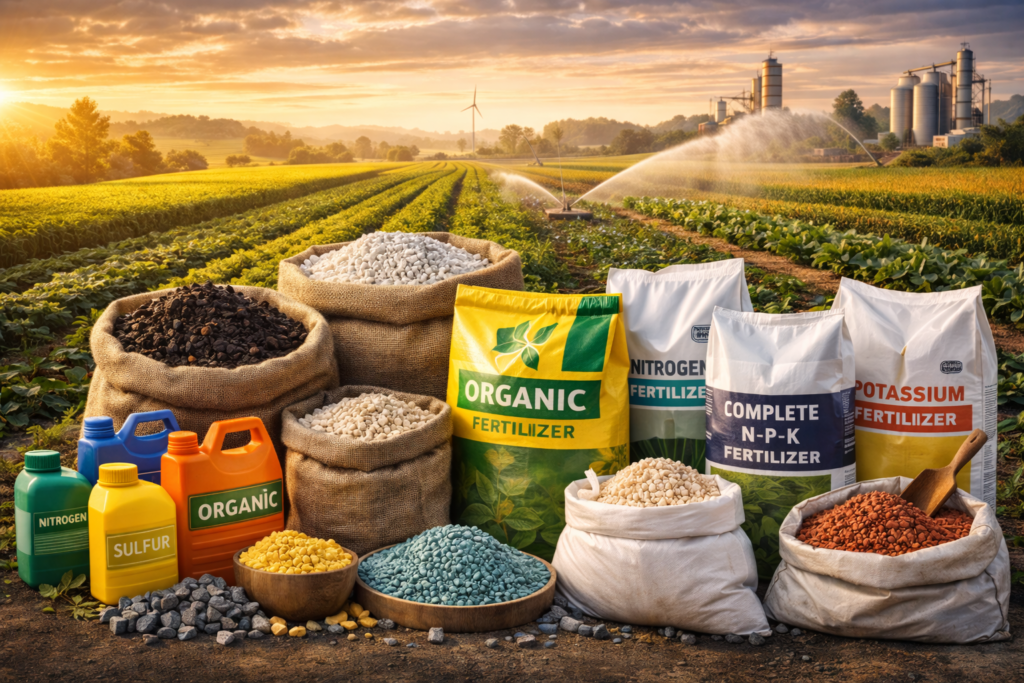
Chemical Fertilizers
UREA N-46
Urea fertilizer is primarily used to supply nitrogen to crops, promoting vigorous growth, leaf development, and high yields. It is one of the most widely applied nitrogenous fertilizers globally.:
Urea N-46% Technical Specification
| Parameter | Specification |
| Nitrogen Content (N) | Min. 46.0% (dry basis) |
| Urea Purity | Min. 98.0% |
| Biuret Content | Max. 0.71–0.90% |
| Moisture Content | Max. 0.3% (Prilled), Max. 0.5% (Granular) |
| Granule Size | 0.85–3.35 mm (Granular), 1–4 mm (Prilled) |
| Free Ammonia | Max. 160 ppm |
| Sulphates | Max. 0.0079% |
| Alkalinity | Max. 0.022% |
| Heavy Metals | As: Max. 10 ppm Cd: Max. 3 ppm Cr: Max. 430 ppm Se: Max. 0.4 ppm Hg: 0% |
| Color | White or Pure White |
| Form | Solid (Granular or Prilled) |
| Solubility in Water | 100g/100ml at 20°C |
| Melting Point | 132°C |
| pH (10% Solution) | 7.5–10.0 |
| Apparent Density | 770–809 kg/m³ |
| Specific Gravity | 1.335 t/m³ |
| Critical Humidity (30°C) | 73% |
| Anti-Caking Agent | Treated for free-flowing handling |
| Radioactivity | Non-radioactive |
| Packaging | Moisture-resistant bags |
Application: Nitrogen fertilizer suitable for all crops and soil types.
NKP
NPK fertilizers are compound blends of three essential nutrients: Nitrogen (N), Phosphorus (P), and Potassium (K), tailored in various ratios to meet specific crop and soil requirements.
Below is a detailed technical specification for common NPK formulations like 20-20-20, 19-19-19, and 12-32-16, which are widely used in agriculture.
NPK Fertilizer – Technical Specification (General Format)
Parameter | Specification |
Formulation Types | 20-20-20, 19-19-19, 12-32-16, 10-26-26, 15-15-15, 6-6-43, etc. |
Total Nitrogen (N) | As per grade (e.g., 20% in 20-20-20) |
Available Phosphorus (P₂O₅) | As per grade (e.g., 20% in 20-20-20) |
Soluble Potassium (K₂O) | As per grade (e.g., 20% in 20-20-20) |
Moisture Content | Max. 1.5% |
Particle Size | 90% of material should pass through 4 mm IS sieve and be retained on 1 mm sieve |
Color | Varies by formulation (white, pink, green, blue) |
Form | Granular, prilled, or water-soluble powder |
Chloride Content | Max. 2.5% (for chloride-sensitive crops) |
Heavy Metals | Within permissible limits (As, Cd, Pb, Hg) |
pH (1% solution) | 6.0–7.5 (for water-soluble grades) |
Solubility | 100% water-soluble for foliar and fertigation grades |
Bulk Density | 0.9–1.1 g/cm³ (granular) |
Compatibility | Compatible with most fertilizers except calcium-based ones |
Packaging | 50 kg HDPE/PP bags with inner liner or bulk |
Shelf Life | 1–2 years under dry storage conditions |
📌 NPK 20-20-20 Water-Soluble Grade
Nutrient | Content |
Total Nitrogen | 20.0% |
P₂O₅ | 20.0% |
K₂O | 20.0% |
Moisture | Max. 0.5% |
Solubility | 100% |
pH (1% solution) | 6.0–7.0 |
Applications:
- 20-20-20: Balanced growth during vegetative and flowering stages
- 12-32-16: Root development and early crop establishment
- 6-6-43: Fruit development and ripening phase
MOP (Muriate of Potash)
Muriate of Potash (MOP), also known as Potassium Chloride (KCl), is a widely used potassium fertilizer with a typical K₂O content of 60–61.7%.
Below is a comprehensive technical specification for standard white or red granular MOP.
MOP (Muriate of Potash) – Technical Specification
Parameter | Specification |
Chemical Formula | KCl |
Potassium Chloride (KCl) | Min. 95–96.7% |
Potassium (as K₂O) | Min. 60.0–61.7% |
Potassium (as K) | Approx. 50.0–51.1% |
Sodium Chloride (NaCl) | Max. 2.1–3.0% (as Na: 0.8–1.1%) |
Magnesium (Mg) | Max. 0.01% |
Calcium (Ca) | Max. 0.01–0.02% |
Sulphate (SO₄) | Max. 0.02% |
Moisture Content | Max. 0.1–0.5% |
Insoluble in Water | Max. 0.02% |
Appearance | White or reddish crystalline granules |
Granulometry (Granule Size) | +1 mm: 0.2% |
Size Guide Number (SGN) | 21 |
Bulk Density | Approx. 1050 kg/m³ |
Angle of Repose | Approx. 28° |
Anti-Caking Agent | Added |
Radioactivity | Non-radioactive |
Packaging | Moisture-proof PP/PE bags (50 kg, or bulk) |
Usage | Fertilizer for crops like sugarcane, potatoes, cereals, oilseeds, and fruits |
Applications: Potassium fertilizer for all crops to enhance yield and disease resistance.
DAP
Di-Ammonium Phosphate (DAP) fertilizer is widely used in agriculture for its high phosphorus and nitrogen content, making it ideal for early crop development and root establishment.
Here’s a comprehensive overview of Di-Ammonium Phosphate (DAP) 18-46-0, covering both its technical specifications and agronomic applications — ideal for procurement, compliance, and field-level guidance.
📋 DAP (Di-Ammonium Phosphate) – Technical Specification
Parameter | Specification |
Chemical Formula | (NH₄)₂HPO₄ |
Total Nitrogen (N) | Min. 18.0% (as ammoniacal nitrogen) |
Available Phosphorus (P₂O₅) | Min. 46.0% |
Water-Soluble P₂O₅ | Min. 41.0–42.0% |
Moisture Content | Max. 1.5% |
Free Acidity (as H₃PO₄) | Max. 0.4% |
Granule Size | 90% between 1 mm and 4 mm IS sieve |
Color | Grey, off-white, or light brown granules |
Bulk Density | 960–1000 kg/m³ |
Solubility in Water | 100% soluble |
pH (1% solution) | 6.0–7.5 |
Critical Relative Humidity | < 80% at 30°C |
Heavy Metals | Within permissible limits (As, Cd, Pb, Hg) |
Radioactivity | Non-radioactive |
Packaging | 50 kg HDPE/PP bags or bulk |
Shelf Life | 1–2 years under dry, cool storage |
🌾 Applications of DAP Fertilizer
Use Case | Details |
Basal Fertilizer | Applied at sowing to supply phosphorus for root development and nitrogen for early growth. |
Cereal Crops | Wheat, rice, maize, and barley benefit from early tillering and strong root systems. |
Pulses & Oilseeds | Enhances flowering and pod formation in chickpeas, lentils, mustard, and groundnut. |
Vegetables & Fruits | Promotes early vegetative growth and root establishment in crops like tomatoes, onions, potatoes, citrus, and bananas. |
Sugarcane & Cotton | Improves shoot development and nutrient uptake efficiency. |
Plantation Crops | Used in tea, coffee, and rubber plantations during early growth stages. |
Nurseries & Transplants | Reduces transplant shock and supports early root establishment. |
Organic Fertilizers
Organic fertilizers are made from plant, animal, or mineral sources. They include compost, manure, bone meal, fish emulsion, green manure, and biofertilizers. Unlike synthetic fertilizers, they improve soil health over time by increasing organic matter and microbial diversity.
Benefits of Organic Fertilizers
- Sustainable: Reduces dependency on chemical inputs
- Soil Health: Enhances microbial life and organic carbon
- Slow Release: Minimizes leaching and nutrient burn
- Eco-Friendly: Lower risk of groundwater contamination
- Improves Crop Quality: Enhances taste, shelf life, and nutritional value